Thursday, March 12, 2020

Wednesday, March 11, 2020
Tuesday, March 10, 2020


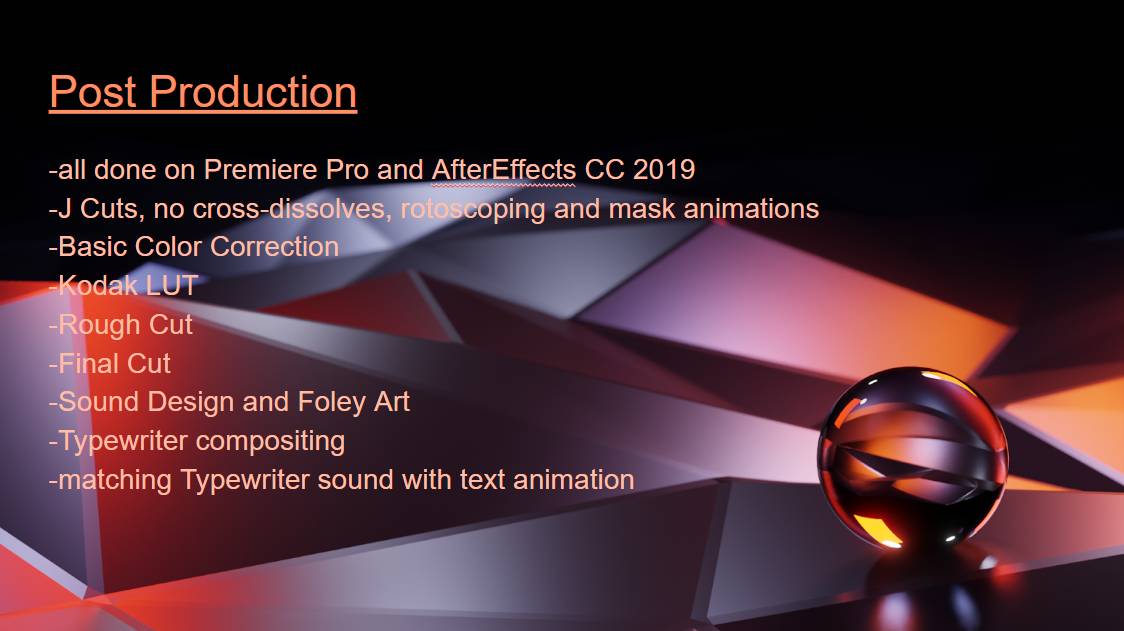


Thursday, January 30, 2020
Editing Rumi's Protege
Finally, I received the footage from Fatima Ali after the winter break and we started editing immediately. Our Director, Sarym and Cinematographer, Fatima came over to my house to help me out in the editing process so that I have their input on everything.


the screen while I was editing

me editing

I was feeling a little adventurous so we made the decision to make a mask animation to transition the shots smoothly (as shown above). It was a very tedious task as I had to move the mask every single frame but it was worth it in the end as it looked amazing.
Fatima and Sarym stayed around until the color-grading stage, which meant I had to do all the sound design on my own.
For sound, most of the ambient sounds recorded on set were filled with a lot of noise and disturbances which simply weren't good enough to add in the final cut. I recorded all the sounds with a method called Foley Art, where you replicate the sounds in the frame with similar objects. Everything was recorded with foley except for the high frequency reverbs.


I was feeling a little adventurous so we made the decision to make a mask animation to transition the shots smoothly (as shown above). It was a very tedious task as I had to move the mask every single frame but it was worth it in the end as it looked amazing.
Fatima and Sarym stayed around until the color-grading stage, which meant I had to do all the sound design on my own.
For sound, most of the ambient sounds recorded on set were filled with a lot of noise and disturbances which simply weren't good enough to add in the final cut. I recorded all the sounds with a method called Foley Art, where you replicate the sounds in the frame with similar objects. Everything was recorded with foley except for the high frequency reverbs.

a screenshot from the assembly stage
Monday, December 30, 2019
The Shooting of Rumi's Protege
We finally began the shooting of Rumi's Protege. We met up at our producer, Zainab Hyat's house and began preparing immediately. The location scouting wasn't much as the only locations used were Zainab's house and our A Levels college campus.


Zainab's garden that showed the protagonist's
"happy place"


"happy place"

The shot for the thumbnail of the film opening

Zainab applying makeup on Mustafa Babar, the protagonist

Shooting the final take in our A Levels College

A celebratory picture with the entire theme along with our cast
It was a really fun and memorable day, however we did come across a few problems while shooting indoors.
The lighting was very dim and we wanted to show sunlight entering the room, luckily we were able to fake it using an artificial light source
The lighting was very dim and we wanted to show sunlight entering the room, luckily we were able to fake it using an artificial light source

faking sunlight with an artificial light source
Tuesday, December 24, 2019
Making Rumi's Protégée: The Animation
I was told to make an animatic of the film opening but I wanted to take that a step further. Even though it might seem overkill, I'm making a fully rendered 3D Animation which is hopefully approx 2-2.5 minutes long.
I'm using Blender 2.8 and its real-time render engine to make the animation.
At the moment, I'm modelling the environments in which the animation will take place. I already have a set of low-poly models already rigged and textured (by me) which will be tweaked a bit to match the needs of this animation

I'm using Blender 2.8 and its real-time render engine to make the animation.
At the moment, I'm modelling the environments in which the animation will take place. I already have a set of low-poly models already rigged and textured (by me) which will be tweaked a bit to match the needs of this animation

Here's the dining room scene so far. I'll add a few props in this as well as a few plates and low-poly food models to show the breakfast scene.
Saturday, December 21, 2019
Risk Assessment Sheet
We had to write down a risk assessment sheet for security purposes of the crew and the actors.


Tuesday, December 17, 2019
25 word pitch
Fatima Ali came up with the 25 word pitch for the film just when we needed it:
"Escaping from the reality of his parents toxic relationship; he comes face to face with his father’s affair but can’t escape this time."
Friday, December 13, 2019
Location Scouting
We have already finalized the locations for our short film. All of the house scenes will take place in Zainab Hyat's (our producer) house.

The Dining Room

The Bathroom where he falls into a trance

The rusty ride and the environment
which will be depicted as his imaginary world
Tuesday, December 3, 2019


Monday, November 25, 2019
Rumi's Protégée: Screenplay
This is the screenplay that Ahmed Sarym, our director wrote:
Scene 1:
The protagonist loses himself to a Sufi dance in the shower, fully dressed, breaking down. He’s transported to a parallel universe where he escapes, he sees himself on a swing; albeit that too, is broken.
Scene 2:
He is interrupted by a phone call from his mom, he gets out of the shower and changes into his uniform.
Scene 3:
He joins his parents at the dining table for breakfast, who are amidst a heated argument. He quietly has his meal, emotionally numb, yet has tears in his eyes.
Scene 3:
He sits in a car with his father, the two travel to his school but no dialogue is shared. He places a notebook on the dashboard of the car.
Scene 4:
He gets off the car and forgets the notebook. As soon as he walks into his institute, he realised his missing notebook and goes back to get it.
Scene 5:
He gets out to see his father driving out of the parking lot with another woman getting into the car. He’s so deeply disturbed by the sight of his father cheating on his mother that he loses himself to dance, again, in the middle of the road and tries to go back, but is unable to and breaks down.
Friday, November 15, 2019
Equipment
For shooting, we will primarily be using Fatima Ali's equipment. A Sony A6500 Mirrorless Camera along with a 50mm f/1.8 for a shallow depth of field.
I'll be using an M1 Boya Mic to record foley sounds for the Sound Design and for the narration as well.
On the editing side, I'll be using my Desktop PC with 16GB RAM and a Radeon RX580 GPU. Footage Assembly will be done in Adobe Premiere Pro, Color Grading in DaVinci Resolve and compositing of visual elements (if any) in Blender 2.8
I'll be using an M1 Boya Mic to record foley sounds for the Sound Design and for the narration as well.
On the editing side, I'll be using my Desktop PC with 16GB RAM and a Radeon RX580 GPU. Footage Assembly will be done in Adobe Premiere Pro, Color Grading in DaVinci Resolve and compositing of visual elements (if any) in Blender 2.8
Sunday, November 3, 2019
Research: Conventions of a Psychological Drama

My technical analysis of the Joker trailer
Most of these films comprised of slow-paced editing which fits the mood as psychological films require more thought to be put in so that they could be properly understood and enjoyed. Short, fast paced editing is quite uncommon as it does not give enough development to the scene in a psychological drama.
Another important role in psychological films is color theory and the type of color-grading that is used. The picture control in the cameras used to shoot the raw footage is set to "Flat" which reduces the contrast in the raw footage so that the colors can be easily and more finely manipulated in post-production to create a final product of much higher quality. Flat style, low contrast footage contains more data and can be manually graded to a much greater extent than the default standard style.
Lawrence Sher, the Head of Cinematography at Joker explains how a Teal hue was used for the overall cool shade of the film whereas deep yellow lights were used for lighting the subjects. The complementary colors on the color wheel (opposite sides of the color wheel) are used for creating a high amount of contrast and set a mood in the film.
Representation of some sort of ability or disability is also very common in psychological films and series. In the case of Joker, the protagonist was shown to have multiple mental disorders including psychopathy.
In the case of the TV Series Mr. Robot, a psychological thriller, the protagonist is shown to have a command over technical computer related elements yet suffers from anxiety disorder and clinical depression.
Most films in the psychological genre deliver a feat which is unconventional from other genres, the protagonist of Joker was shown painting his tongue in the trailer which is something very unusual and out of the norm.
Although the camerawork is not special in most psychological films, there may be a few scenes where handheld footage is shown with a little bit of shake to portray an unsettling situation.
Sunday, October 27, 2019
Rumi's Protégée: Synopsis

Ahmed Sarym's synopsis of "Rumi's Protégée"
"In sheer isolation, a guy fully clothed in a shower transports to a parallel universe immersing himself in dance before he is interrupted by a call from his mother. He changes into his uniform for school, joins his family on the dining table for breakfast but the clamour and constant arguments makes him walk away with his bag to the car
His father joins him and no dialogue is shared throughout the ride to school. He gets off and enters the school but realizes he forgot his bag in the car.
He goes outside but sees his father driving off with another woman. He wants to transport back but is unable to, so he physically runs and escapes from reality."
His father joins him and no dialogue is shared throughout the ride to school. He gets off and enters the school but realizes he forgot his bag in the car.
He goes outside but sees his father driving off with another woman. He wants to transport back but is unable to, so he physically runs and escapes from reality."
Monday, October 21, 2019
Film Idea: Rumi's Protégée
That's the title our Director, Ahmed Sarym came up with.
"Rumi's Protégée", a lot of thought went into making the film title.
The main source of inspiration has to be the 13th century poet and philosopher, "Jalāl ad-Dīn Muhammad Rūmī". The "Sema" is a famous Sufism ritual and dance that originated from the hammering of a goldsmith.
Rumi was once approaching a goldsmith and the sound of a hammer felt melodic to him. It caused him to feel dizziness after doing a whirling dance synced with the "melody" of the hammer. The dizziness caused Rumi to fall into a trance and become ecstatic. Soon, the sound of the hammering gold vanished and all that was left was this sense of spirituality.
The Sema and Rumi play a large role in our film project as the protagonist of our film opening will be shown as a reborn apprentice of Rumi that uses a variant of the Sema to lose himself into a trance and transport to his imaginary world
Other inspirations included were:
"Rumi's Protégée", a lot of thought went into making the film title.
The main source of inspiration has to be the 13th century poet and philosopher, "Jalāl ad-Dīn Muhammad Rūmī". The "Sema" is a famous Sufism ritual and dance that originated from the hammering of a goldsmith.
Rumi was once approaching a goldsmith and the sound of a hammer felt melodic to him. It caused him to feel dizziness after doing a whirling dance synced with the "melody" of the hammer. The dizziness caused Rumi to fall into a trance and become ecstatic. Soon, the sound of the hammering gold vanished and all that was left was this sense of spirituality.
The Sema and Rumi play a large role in our film project as the protagonist of our film opening will be shown as a reborn apprentice of Rumi that uses a variant of the Sema to lose himself into a trance and transport to his imaginary world
Other inspirations included were:
- Inner Worlds, Outer Worlds (2012)
- Waking Life (2001)
- Boyhood (2014)
Thursday, October 10, 2019
Our roles

These are our decided roles for the film opening project.
I'm responsible for the editing and sound design and am doing the camerawork alongside Fatima Ali.
I'll be doing all the editing and post-production in Adobe Premiere Pro.
Fatima will be helping me out with cinematography and deciding what creative shots and techniques to use and when.
I'll be doing all the editing and post-production in Adobe Premiere Pro.
Fatima will be helping me out with cinematography and deciding what creative shots and techniques to use and when.
Thursday, October 3, 2019
Preliminary Exercise: Point Lighting
Today in class we were being taught the absolute basics of Lighting and Point Lighting specifically. My Media Studies teacher, Sir Nadeem Zulfiqar, started off by switching off all the lights in the classroom and told a handful of students to switch on their phone torches. Point Lighting is the most common form of lighting found in studios and 3-point lighting is the standard that's adopted by most studios.
In a 3-point lighting system, the "Key Light" is the main source of illumination for the subject. It's the brightest light source that is used on set.
The "Fill Light" is the second source of illumination on set. Its brightness is usually around 60% of the Key Light's brightness and is used to fill in the harsh shadows that are left by the Key Light. Fill Lights are almost always diffused so that the sharp shadows can be replaced with aesthetically pleasing soft shadows. Both of these lights are usually positioned at a 45 degree angle on the Z Axis and are placed high above the subject.
The third type of light is the backlight. The backlight is positioned right behind the subject and can be used in a few different ways. If the subject has a dark backdrop, the backlight can be used to shine light towards the background, creating a very pleasing backdrop that defines the subject and makes it stand out from the background, just like how "bokeh" is created in a lens with a wider aperture. Another way to use it is by shining the backlight towards the subject and thus creating an outline of the subject. This method is called the "Rim Light". Both are very commonly found in studios and each serve their own purpose. Lighting the background with the backlight is a good way of defining a human character from the backdrop and gives a very professional and clean look.
The room was darkened so that we could use our phone torches to light the model and take interesting photos. We used a 1-point lamp system, a 2-point lamp system and a 3-point lamp system. One tiny detail I should tell is that I was the model in this case. I wasn't able to take any photos of my own but I simulated whatever happened in the class by making 3D renders in Blender 2.8

This was the 1-point lamp system. It was fairly simple. I imported my 3D Models from previous projects, created a plane mesh, increased its scale and extruded the edges to resemble a room studio. The Point Lamp's size and radius was decreased so that I can ensure those harsh edges on the shadows. The wattage was 50 watts.

The two-point lamp system was also simple. I duplicated the key light, placed both on opposite ends of the monkey head and it created a rather unique shadow. Lighter shadows can be seen on opposite ends of the chair and the darker shadow can be seen right below the chair with no angle. As for the monkey, lighting can be seen on both ends of the head but a very dark shadow line down the middle.

The three-point lighting system took the longest to render because of how many light bounces were occurring in different areas of the frame. The key light is in the same position as it was in the 1-point lamp system, I added an area lamp with 45 watts and a wide radius as the Fill Lamp. The large scale of the area lamp and the lower wattage gave softer shadows and did not create any significant reflection on the right side of the monkey head. The backlight was very soft but it did create a soft outline around the chair if you look closely. I just duplicated the key light and reduced its wattage to 30 watts.
Monday, September 30, 2019
My Introduction
Hello Everyone, I'm Zunain Faisal.
I'm 17 years old and an AS Levels Media Studies Student at Roots IVY F-8 Campus. This blog is made to track my progress and development of the Film Opening Project for my A Levels.

I'll be making the Film Project as a group project with my partners Zainab Hyat, Fatima Ali and Ahmed Sarym.
More about me, my hobbies include Photography, Cinematic Videography and 3D Modelling. I want to work in the VFX Field and specialize in CGI.
I believe taking Media Studies in A Levels will definitely help me in reaching my goals.
To end this introduction properly, here's a 3D Render of an apple I made recently in Blender 2.8 :)

Subscribe to:
Posts (Atom)